I don't really understand this memo. I also worked at PARC when Pike was there though I didn't interact with him or even know he was there. If he hadn't said PARC and Dolphin up front I would have thought he was talking about a completely different place.
There were, barely enough Dorados to go around; I worked mostly at night so I could be sure to get one, but as far as I remember everybody had a console on their desk (keyboard/mouse/bitmapped display). Perhaps, as he was a visitor, he didn't have a desk of his own?
Dorados were ECL machines (so obviously quite expensive), part of a family of D-machines (Dolphin was an earlier, less powerful machine, and the Dandelion workstations (which didn't need to be in a machine room) were later marketed as the Star. Typically you booted up an entire environment (including environment-specific microcode -- I wrote some of that): Smalltalk, Interlisp-D or Cedar/Mesa. Each language environment was a complete OS written in that language.
It's possible that he had previously never had had access to dedicated single user machines like that; by the time I went to PARC I was used to having CADRs at MIT (again, in machine rooms with the consoles in offices) so the concept of these machines was unremarkable in itself.
But what he says about files and FTPing stuff around makes no sense. The environment by 1984 was heavily networked, with the email system (like a modern IMAP environment) entirely client/server living abstractly as a network service. Files lived on fileserver too and opening a remote file was, well, how you did things. Since I didn't have a dedicated machine once I connected to one I simply booted up and had my whole environment available. I never used FTP at all. Similarly what he said about not saving state unless he was using an Alto (or running the big D machines in Alto mode -- then they did have local disk). The other environments all inherently saved state, like a modern iOS or Mac app. Likewise the three environments I mentioned all handled integrated printing as would be familiar to anyone today -- and by 1984 (actually by the late 70s) there were laser printers (Dovers and even color Pengin printers) which were lickety-split; you rarely waited.
In fact his statement "In fact, the whole world outside your machine, Ethernet notwithstanding, is a forbidding world." is cute but inexplicable: not only were various resources available on the net in what we'd call today an any cast (see what I wrote above about grapevine, the mail system) but by 1984 the ARPAnet had switched over to TCP so I routinely transparently used resources from MIT from my Interlisp environment similarly to how you might open a URL in a text editor today.
I agree with what he said about not using text editors in a traditional mode (Interlisp's preferred mode was a structure editor) and indeed it would have been nice to have had 'grep' in Smalltalk!
It reads as if he was unfamiliar with exploratory programming environments (like Smalltalk, Interlisp, and the Lispms). He's clearly trying to map the debug-exit-edit-compile-restart model onto a different paradigm, that of an integrated interpreted-compiled environment. I had the same experience in reverse when I started using Unix: it was weird to me that an error caused the process to exit and dump core; I was used to an error in any application stopping and entering the debugger with all file, process, network etc descriptors all live and inspectable/pokeable and being able to fix the bug in situ and continue. That was the 1970s programming environment I'd learned on.
He did have access to dedicated single-user machines like that; in fact he built some of them himself with Bart Locanthi a couple of years before. But he had no idea what to do with them, so he programmed them to act as multiwindow terminals for a remote Unix system, running a window system over a serial line. I know that sounds like a joke but it sounds like it was kind of cool — I'd love to play with a Blit (oh hmm, they've released the firmware and an emulator in 9front and 8th Edition Research Unix) — but it also sounds like a real waste of a 68000 to me.
I think the thing he was saying about FTP was when the only copy of a file he wanted was on somebody else's local disk. It sounds like he was doing more stuff with Dorados pretending to be Altos than was normal at the time, and, yes, trying to get them to act like batch-mode programming environments.
(Didn't Cedar's FS support having local files too? Obviously I've never used Cedar, just read papers about it.)
> Didn't Cedar's FS support having local files too? Obviously I've never used Cedar, just read papers about it.
It may have but I only farted around in it bc my real job was in interlisp (plus it was strongly typed iirc which i was allergic to in those days). Yeah, all the D machines booted into an Also mode (which itself was a kind of NOVA).
Even the KL-10 clone (MAXC) had an Alto as its front end processor (real dec ones used a PDP-11!)
I too recall early encounters with Smalltalk (albeit 1989), and also recall that feeling of missing grep - and it was only years later that I realised I had missed a hugely important point... possibly the most important point. Smalltalk is so elegant, malleable and simple that it was only 5 lines of code to implement a more interactive grep... d’oh. Why didn’t I think of it at the time? Too cocky?
Code completion was trivial to implement even back then, particularly as code is an object like anything else. Sometimes you miss the obvious and hold yourself back.
Sadly the industry hasn’t innovated much since PARC, those much mailigned Smalltalk images are now called Docker ;)
>One philosophical point is that each window is of a type: a browser, a debugger, a workspace, a bit editor. Each window is created by a special action that determines its type. This is in contrast to our style of windows, which creates a general space in which anything may be run. With our windows, it is easy to get to the outside world; the notion of Unix appears only when a Unix thing happens in the window. By contrast, Smalltalk windows are always related to Smalltalk. This is hard to explain (it is, as I said, philosophical), but a trite explanation might be that you look outwards through our windows but inwards through theirs.
I think he's saying that he's used to each program running in its own address space with its own windows all of which appear on a common desktop. Like a Mac or Windows machine today.
While in Smalltalk, Interlisp and Cedar, the language environment controls the entire machine with a common address space so every window is a view into code running (multithreaded) in a single environment. E.g. if you change a smalltalk method every window will immediately start using the updated code.
I understand what he's talking about with Smalltalk windows, but it's unclear to me what these "outwards-looking" Unix windows would have been in 1984.
Is he talking about X and how a remote client app can freely render in a display server window using the (rather awful) X primitives?
No, Bob Scheifler's message, "I've spent the last couple weeks writing a window system for the VS100. I stole a fair amount of code from W, surrounded it with an asynchronous rather than a synchronous interface, and called it X," was 1984-06-19, and I don't think it escaped MIT until 1985; Pike surely wasn't talking about X two months before. Danny's inference that Pike was talking about the Blit is probably correct — the Blit (from 1983) does operate the way Pike described, and X normally operates the way Smalltalk did, with each window owned by a client application that gives it idiosyncratic behavior.
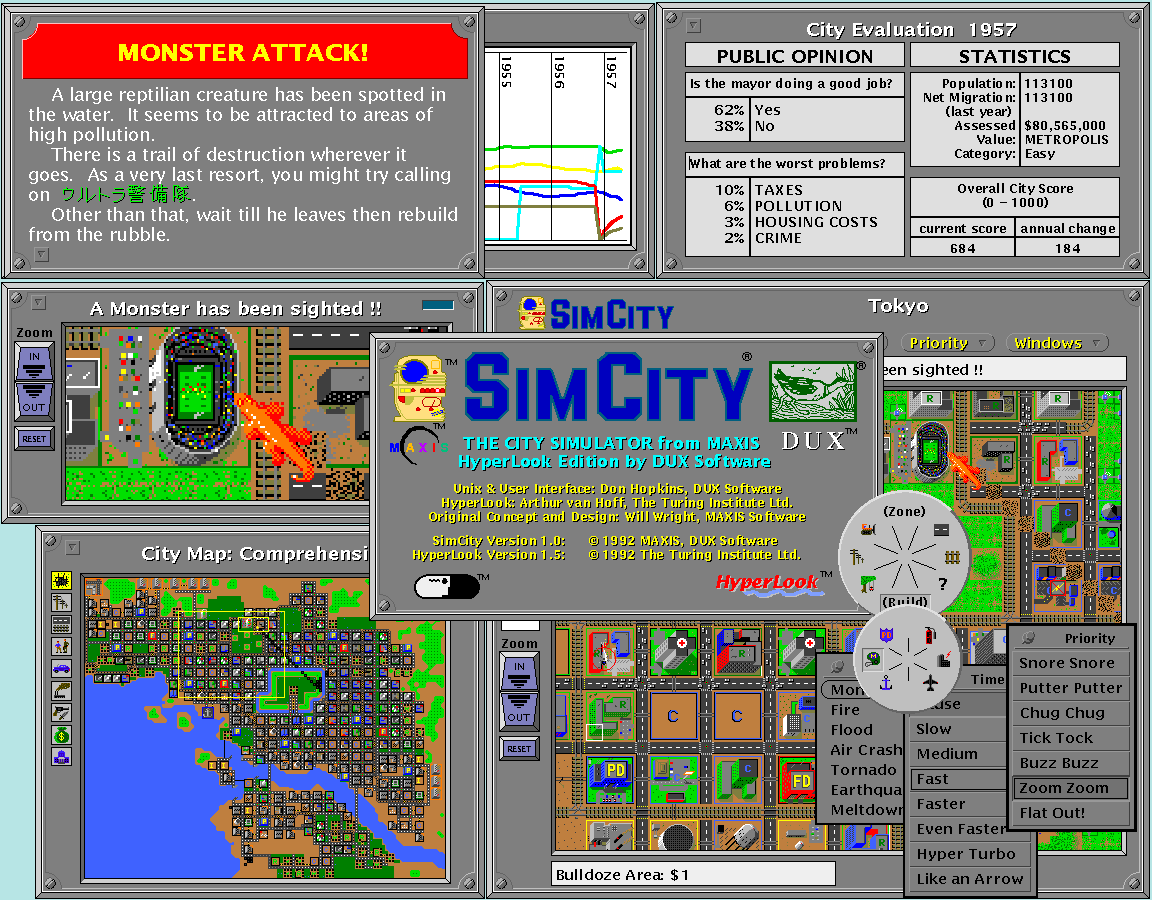
HyperLook (which ran on NeWS, and was like a networked version of Hypercard based on PostScript) was kind of like looking outwards through windows, in the way Rob Pike described the Blit (although it was architecturally quite different).
I think his point was that window frames should be like dynamically typed polymorphic collections possibly containing multiple differently typed components that can change over time (like JavaScript arrays), not statically typed single-element containers that are permanently bound to the same component type which can't ever change (like C variables).
With X11, the client comes first, and the window manager simply slaps a generic window frame around it, subject to some pre-defined client-specified customizations like ICCCM properties to control the window dressing, but not much more, and not under the control of the user.
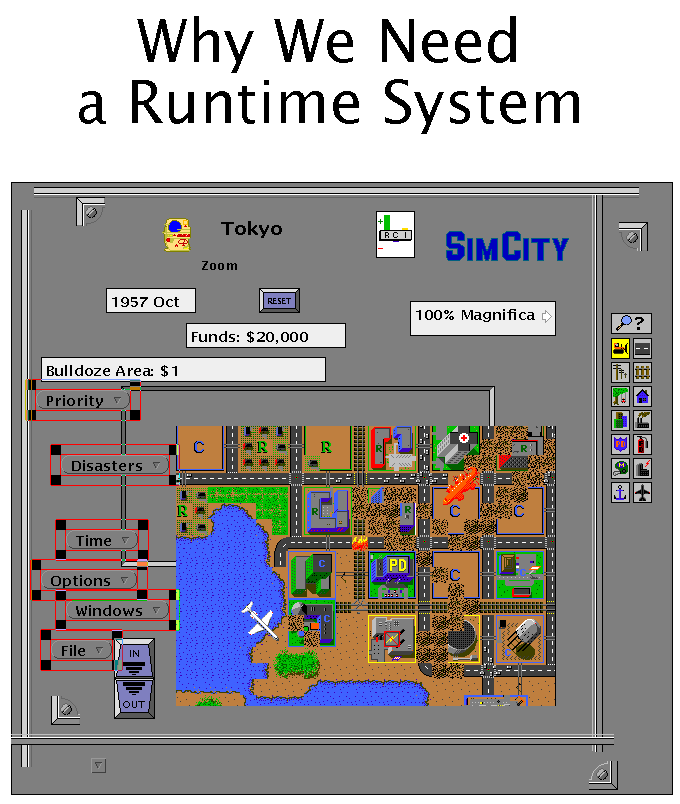
With HyperLook, the "stack/background/card" or window frame came first, and you (the user at runtime, not just the developer at design time) could compose any other components and applications together in your own stacks, by copying and pasting them out of other stacks or warehouses of pre-configured components.
For example, I implemented SimCity for HyperLook as a client that ran in a separate process than the window server, and sent messages over the local network and drew into shared memory bitmaps. SimCity had its own custom frames ("screw-up windows") that looked more "mayoral" than normal windows.
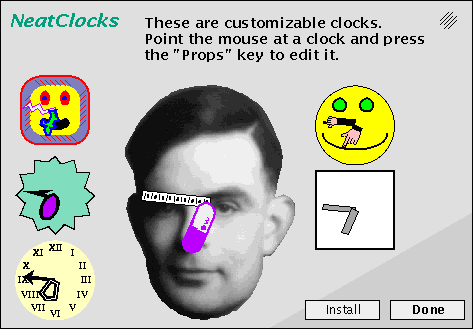
There were multiple map and editor views that you could copy and paste into other stacks while they were running, or you could copy widgets like buttons or drawing editors into the SimCity stack while it was running. So you could copy and paste the "RCI" gauge into your graphics editor window to keep an eye on it while you worked, or paste a clock into your SimCity window to see when it was time to stop playing and get some sleep. And you could even hit the "props" key on the clock to bring up a PostScript graphics editor that let you totally customize how it looked!
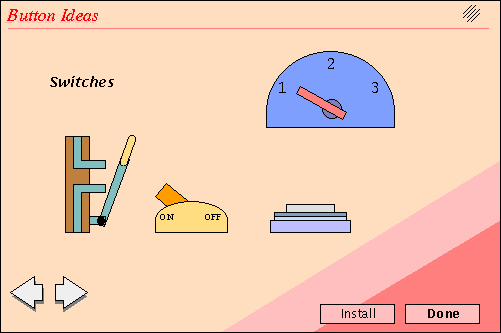
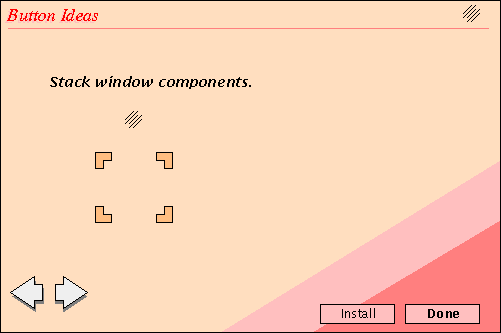
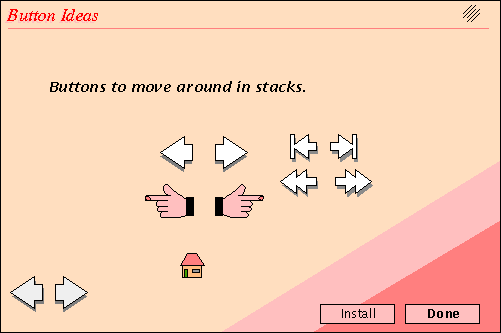
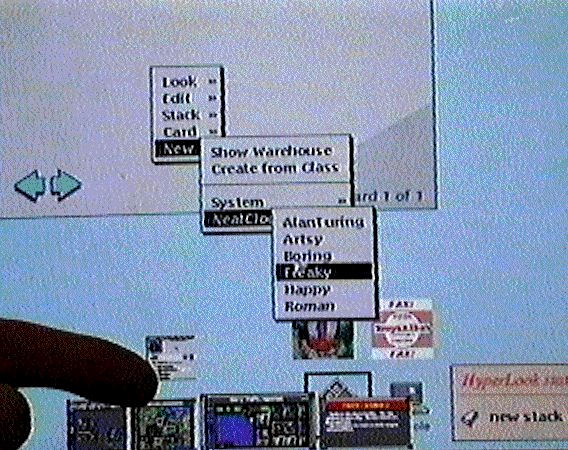
It had "warehouse" stacks containing collections of pre-configured component prototypes (including widgets, applets, and window management controls like close buttons, resize corners, navigation buttons, clocks, graphics editors, etc) that you could copy and paste into your own stacks, and which would automatically be listed in the "New Object" menu you get in edit mode, to create them in place without opening up the warehouse:
Normal X11 window managers put the cart before the donkey. The window frames are generic, stupid and unscriptable, and can't even be customized by the user, or saved and restored later. The client comes first, with just one client per generic frame. You can't move or copy a widget or panel from one frame to another, to use them together in the same window. That's terribly limited and primitive.
We implemented a more-or-less traditional (but better than normal) ICCCM X11 window manager in PostScript for X11/NeWS, which had tabbed windows, pie menus, rooms, scrolling virtual desktop, etc, uniformly for all NeWS apps and X11 clients. But the next step (not NeXT Step) was to use HyperLook to break out of the limited one-client-per-frame paradigm.
(It's interesting to note that David Rosenthal, the author of the ICCCM specification, was also one of the architects of NeWS, along with James Gosling.)
Our plan was to use HyperLook to implement a totally different kind of integrated scriptable X11 (and NeWS) window manager, so you could compose multiple X11 clients into the same frame along with HyperLook widgets and scripts. You could integrate multiple X11 clients and NeWS components into fully customizable seamless task oriented user interfaces, instead of switching between windows and copying and pasting between a bunch of separate monolithic clients that don't know about each other. But unfortunately Sun canceled NeWS before we could do that.
Here's some more stuff I've written about that stuff, and how window managers should be implemented today in JavaScript:
>This is a discussion of ICCCM Window Management for X11/NeWS. One of the horrible problems of X11/NeWS was window management. The X people wanted to wrap NeWS windows up in X frames (that is, OLWM). The NeWS people wanted to do it the other way around, and prototyped an ICCCM window manager in NeWS (mostly object oriented PostScript, and a tiny bit of C), that wrapped X windows up in NeWS window frames.
>Why wrap X windows in NeWS frames? Because NeWS is much better at window management than X. On the surface, it was easy to implement lots of cool features. But deeper, NeWS is capable of synchronizing input events much more reliably than X11, so it can manage the input focus perfectly, where asynchronous X11 window managers fall flat on their face by definition.
>Our next step (if you'll pardon the allusion) was to use HyperNeWS (renamed HyperLook, a graphical user interface system like HyperCard with PostScript) to implemented a totally customizable X window manager!
> I think his point was that window frames should be like dynamically typed polymorphic collections possibly containing multiple differently typed components that can change over time (like JavaScript arrays), not statically typed single-element containers that are permanently bound to the same component type which can't ever change (like C variables).
Well, dynamically typed, yes, and changing over time, but I don't think he was talking about sticking your editor and your command line in the same window at the same time. Rather, you could run a program in an mpx window on the Blit, and it would draw in that window until it was done, and then you would get your shell prompt back in that window.
I know this isn't really related to the overall question of end-user customizability and composability that you're focusing on here, but I dig the olwm-style pinned dropdown menus in your last screenshot there. It's a shame neither Open Look nor olwm nor olvwm ever did antialiased text — I know it was important for the window manager not to eat the entire palette of your cgfour or NCD, but when all your chrome text is black on slate grey, a couple of greyscale levels would have gone a long way.
Your other links are timely, since I'm trying to figure out how to do the BubbleOS windowing system Wercam this week, maybe using Unix-domain sockets and shared-memory bitmaps, or rather pixmaps; the thing that sounds most inspiring to me is Genode's nitpicker, but supporting the interposition-based design of the nitpicker window manager would require either an extra copy of all the pixels (to put them in the right place in the framed window) or a draw command that involves a whole sequence of rectangles instead of just one. I'm kind of thinking that by default windows will be embedded in my shell, like graphics in Jupyter, and then I'll see how things go from there. https://gitlab.com/kragen/bubbleos/tree/master/wercam
For the life of me I will never understand this opinion. If you're trying to eek out the last bits of memory, fine, verbosity is a valid concern, but at least today code should be written to be read by a human, the more easily it can be read and understood the better.
You can calculate the (population) standard deviation of a set of data as the square root of the difference between the mean of the squares of the data and the square of the mean of the data. Is that easier to understand than √(Σ(xᵢ²/N) - (Σxᵢ/N)²)?
If you're one of the two and thirteen one-hundredths percent of the population that said "yes" to that, can you explain how to derive that formula (which gives a one-pass algorithm) from the fundamental definition √(Σ((xᵢ-x̄)²)/N)? Or, rather, that the standard deviation is the square root of the mean of the differences between the data and their mean? Without using any formulas, remember, because the position you're defending is that sequences of words are more easily read and understood by humans than mathematical formulas are. But convincingly.
The benefit of notation as a tool of thought is not that it saves memory in the computer; it's that it enables you to think thoughts that you could not have thought with an inferior notation.
That is a good point, I would refine my argument a based on your response.
√(Σ(xᵢ²/N) - (Σxᵢ/N)²) is unhelpful on its own, and as you point out a more "human readable" version of this equation would be rather convoluted. The middle ground here would be to use more specific syntax like yours, while also ensuring that each variable is clearly defined and this logic is robustly documented to explain both the why of this function and how this specific function carries out that logic.
The justification for why that formula is correct (equivalent to the fundamental definition) is even more incomprehensible than the formula itself if written in English, but fairly clear, almost trivial, using algebraic notation. That is, if you want to "explain both the why of this function and how this specific function carries out that logic," using algebraic notation is far, far better than just using a natural language.
meta: There's a <style> tag with 2400 lines (47k+ characters) - a 'Blogger Template Style' - occupying most of the page source. Guess I shouldn't be surprised at the length, but I was. ...What's the record for that sort of thing?


There were, barely enough Dorados to go around; I worked mostly at night so I could be sure to get one, but as far as I remember everybody had a console on their desk (keyboard/mouse/bitmapped display). Perhaps, as he was a visitor, he didn't have a desk of his own?
Dorados were ECL machines (so obviously quite expensive), part of a family of D-machines (Dolphin was an earlier, less powerful machine, and the Dandelion workstations (which didn't need to be in a machine room) were later marketed as the Star. Typically you booted up an entire environment (including environment-specific microcode -- I wrote some of that): Smalltalk, Interlisp-D or Cedar/Mesa. Each language environment was a complete OS written in that language.
It's possible that he had previously never had had access to dedicated single user machines like that; by the time I went to PARC I was used to having CADRs at MIT (again, in machine rooms with the consoles in offices) so the concept of these machines was unremarkable in itself.
But what he says about files and FTPing stuff around makes no sense. The environment by 1984 was heavily networked, with the email system (like a modern IMAP environment) entirely client/server living abstractly as a network service. Files lived on fileserver too and opening a remote file was, well, how you did things. Since I didn't have a dedicated machine once I connected to one I simply booted up and had my whole environment available. I never used FTP at all. Similarly what he said about not saving state unless he was using an Alto (or running the big D machines in Alto mode -- then they did have local disk). The other environments all inherently saved state, like a modern iOS or Mac app. Likewise the three environments I mentioned all handled integrated printing as would be familiar to anyone today -- and by 1984 (actually by the late 70s) there were laser printers (Dovers and even color Pengin printers) which were lickety-split; you rarely waited.
In fact his statement "In fact, the whole world outside your machine, Ethernet notwithstanding, is a forbidding world." is cute but inexplicable: not only were various resources available on the net in what we'd call today an any cast (see what I wrote above about grapevine, the mail system) but by 1984 the ARPAnet had switched over to TCP so I routinely transparently used resources from MIT from my Interlisp environment similarly to how you might open a URL in a text editor today.
I agree with what he said about not using text editors in a traditional mode (Interlisp's preferred mode was a structure editor) and indeed it would have been nice to have had 'grep' in Smalltalk!
It reads as if he was unfamiliar with exploratory programming environments (like Smalltalk, Interlisp, and the Lispms). He's clearly trying to map the debug-exit-edit-compile-restart model onto a different paradigm, that of an integrated interpreted-compiled environment. I had the same experience in reverse when I started using Unix: it was weird to me that an error caused the process to exit and dump core; I was used to an error in any application stopping and entering the debugger with all file, process, network etc descriptors all live and inspectable/pokeable and being able to fix the bug in situ and continue. That was the 1970s programming environment I'd learned on.